Home / Field Guide
The Stellenbosch Window Field Guide
Light, heat and heritage, elevation by elevation — how the Winelands sun actually hits a Cape Dutch or wine-estate home here, and which blind we'd specify where.
Home / Field Guide
Light, heat and heritage, elevation by elevation — how the Winelands sun actually hits a Cape Dutch or wine-estate home here, and which blind we'd specify where.
This guide is also a PDF you can download and read offline (12 pages).
Why Stellenbosch is its own case
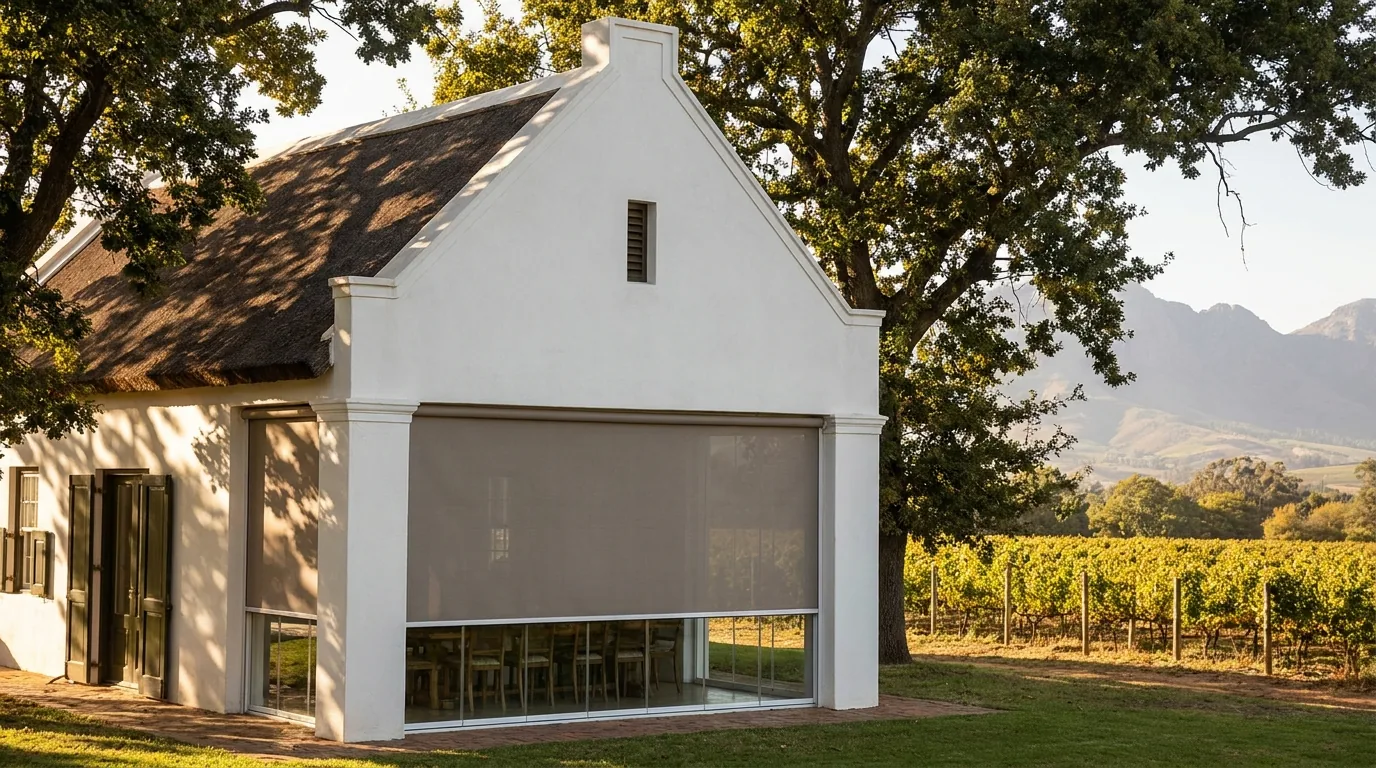
Stellenbosch asks two opposite things of a blind at once. The historic core is full of whitewashed, gabled Cape Dutch homes with deep-set sash windows that pre-date any factory-standard size, while the new wine and golf estates went the other way entirely — walls of glass pointed straight at the vines. One town, two problems, and a Mediterranean sun that is genuinely fierce between them.
This guide is the thinking we bring to a Stellenbosch measure before we quote a rand: it walks the sun around the house, names which elevation suffers and when, and says plainly which product we'd reach for on each — and where the cheaper option is honestly good enough. It won't replace a measure, but it lets you arrive at one already knowing what you're looking at. Everything below is grounded in Stellenbosch's own climate, geography and building stock, with sources at the foot of the page.
The light here
Stellenbosch sits at about 33.9° south. In the southern hemisphere that means the sun tracks across the northern sky, and the angle changes dramatically with the season. At midsummer the noon sun climbs to roughly 80° above the horizon — almost straight down — so a north-facing window takes near-vertical sun that even a modest eave can intercept. At midwinter that same noon sun sits low, around 33°, and reaches deep into north rooms, which is warmth you actually want in a wet Cape July.
The hard cases are east and, especially, west. Low morning sun rakes straight into east-facing glass; low late-afternoon sun does the same from the west, at the exact time the day's heat has peaked. West elevations are where glare and heat are worst, and where a high overhead eave does nothing because the sun is coming in sideways.
Summers are hot and very dry — January and February average highs sit around 28–29°C and push into the low-to-mid 30s inland, under 10 to 11 hours of daily sun. Because Stellenbosch is inland, beyond the first mountains, it gets less sea-breeze relief than coastal Cape Town, so unshaded glass holds that heat well into the evening.
Two more Stellenbosch specifics change the brief. First, the south-easter — the "Cape Doctor" — blows strongly from roughly September to March, usually peaking in the late afternoon, and funnels harder against the mountainside suburbs than the sheltered town centre; anything outdoors has to be planned around it. Second, UV is extreme: the greater Cape runs a summer UV index of 11 to 13 on the WHO scale, fading fabrics, timber and floors faster on the sun elevations — a real argument for stopping the sun outside the glass. And unlike the Highveld, the wet season is the mild winter (June–July are wettest), so the test for a patio cover here isn't summer hail — it's wind, plus a wet Cape winter you either can or can't sit out in.
Room by room, wall by wall
Most Stellenbosch homes have at least two of these four situations at once — an oak-shaded front and a baking garden wing, or a cool heritage core and a glazed new addition. So each elevation earns its own answer, not one blanket blind forced onto the whole house.
The prime elevation — high overhead sun in summer, welcome low warmth in winter. Living areas here want something that cuts summer glare without killing the winter gain: an adjustable or view-preserving blind beats a heavy blockout that you'd fight all winter.
Low, direct, hot late-afternoon sun exactly when the day is hottest. Glare on screens and TVs, furniture fade, rooms that stay warm past sunset. This is the elevation that most rewards stopping the heat outside the glass.
Sharp low sun early, then comfortable for the rest of the day. Bedrooms and breakfast rooms here are the classic case for a blockout layer you can lift once the sun is up — an adjustable or dual system earns its keep.
Little direct sun year-round, so heat and fade are rarely the issue. Here the brief is usually privacy, softening flat light, and insulation on cold winter nights rather than sun control.
What we'd specify, and why
Each pick below carries a "Works well for" and a "Trade-off" — because there's no single best blind, only the best one for that window. Tap add on any of them and we'll carry it to your ballpark and measure request, so you never re-type it.
Keep the vineyard, or dial the privacy.
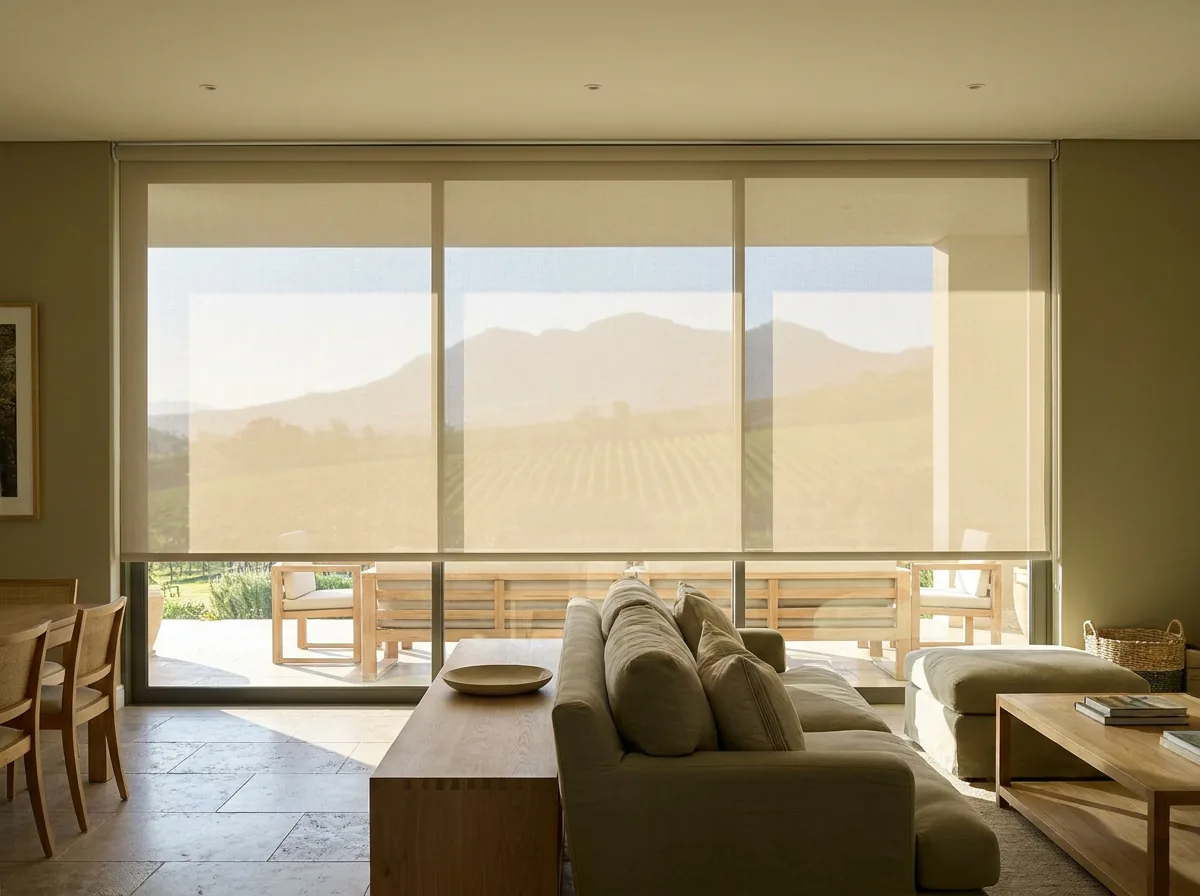
On a wall of glass facing the vines or the Simonsberg, a sunscreen-mesh roller is usually the first thing we'd hang. The mesh knocks down glare and blocks much of the UV while you still read the view straight through it — the whole reason those windows exist. Working on the inside of the glass, it manages glare and UV beautifully and heat reasonably; on the punishing west elevation we'd often upgrade it (see external venetians below). For a room fronting an oak avenue, a day/night version — sheer and solid bands sliding past each other — dials from open view to full privacy without ever going fully dark.
View-first north and garden elevations; street-facing lounges wanting graded privacy rather than a simple on/off.
Neither is a true blackout — after dark a lit room stays partly visible, and a bedroom needs the blockout below. Day/night's twin fabric also costs more than a single roller.
Stop the heat before it reaches the glass.
On the worst west-facing rooms, we'd argue for aluminium venetians mounted outside the window. The physics is the honest reason: an external louvre reflects the sun before it ever touches the pane, so the glass never becomes a radiator. An interior blockout roller looks like it does the same job, but by then the sun has passed through the glass and the pane is warming the room — the roller just hides it. Tilt the louvres and you keep a filtered view while the heat stays outside.
West and north-west living rooms and kitchens that overheat by mid-afternoon; the biggest real-world temperature difference of anything here.
The most involved option — it costs more than an interior blind, needs external mounting and (if motorised) power, moving parts outdoors want occasional care, and estates will want to sign off the colour. A plain interior blockout is far cheaper if you can live with a warmer room.
A dark room on a bright Boland morning.
For bedrooms — especially east-facing ones that catch the early sun — a true blockout roller is the simplest honest answer: a single smooth fabric that drops flat and shuts the light out. Where a room needs both a soft daytime option and full darkness at night, a day/night double roller (below) or a blockout paired with a sunscreen on one bracket does both jobs.
Bedrooms, nurseries, media rooms — anywhere darkness and simple, child-safe operation matter more than keeping a view.
Blockout is all-or-nothing during the day; you lose the view when it's down. If you want to hold the outlook and still dim, a sunscreen or day/night suits better.
A blind that belongs on a two-hundred-year-old window.
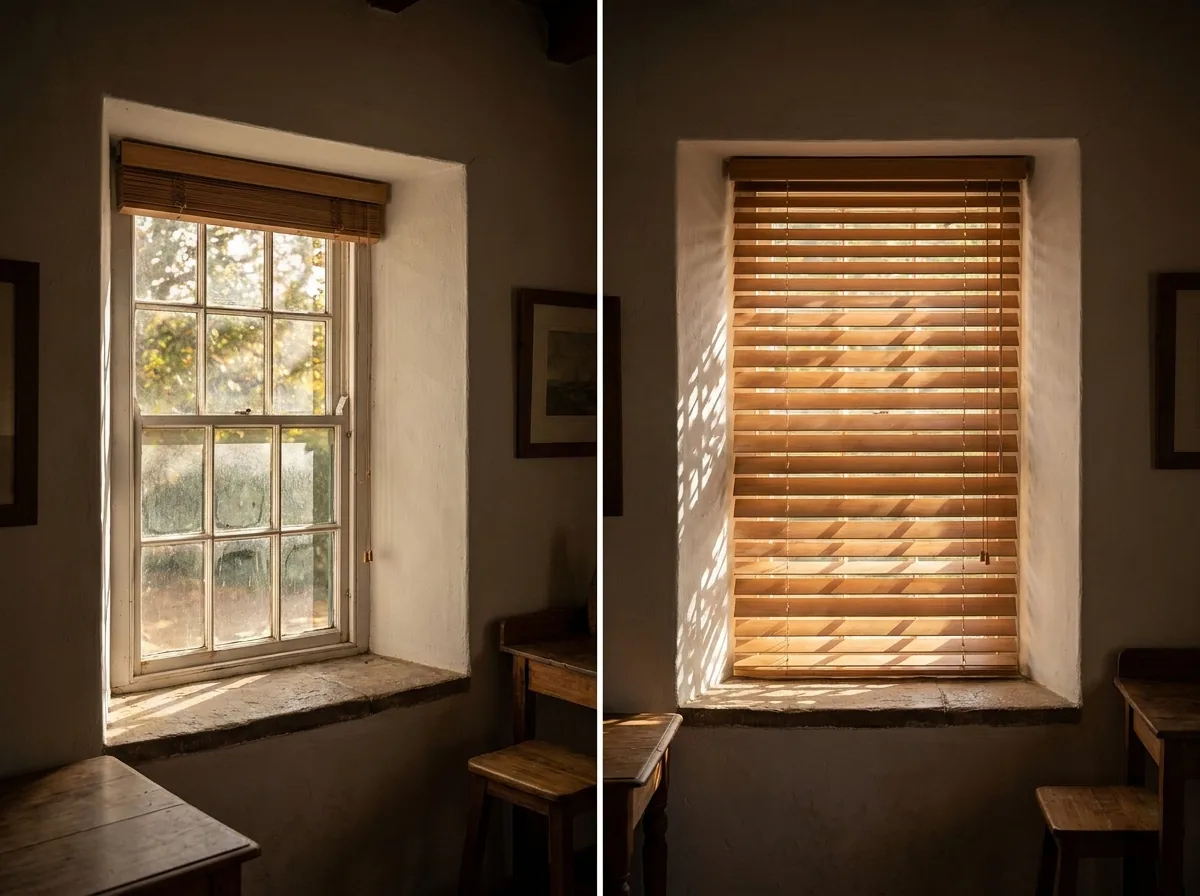
On the town's older homes, warm basswood venetians sit comfortably with heritage joinery in a way aluminium never quite manages, and their tilt gives you fine control over filtered daylight and privacy on a deep-set sash window. They read as part of the room, not a modern add-on.
Lounges, studies and dining rooms in Cape Dutch, Victorian and farm-style homes; heritage reveals where a soft, natural material matters.
Real timber dislikes steamy bathrooms and busy kitchens and can bow with constant damp — in wet areas we'd switch to an aluminium venetian, which loses the warmth but shrugs off moisture. On very tall sashes the raised slat stack is also deeper.
Trapped air, working in both directions.
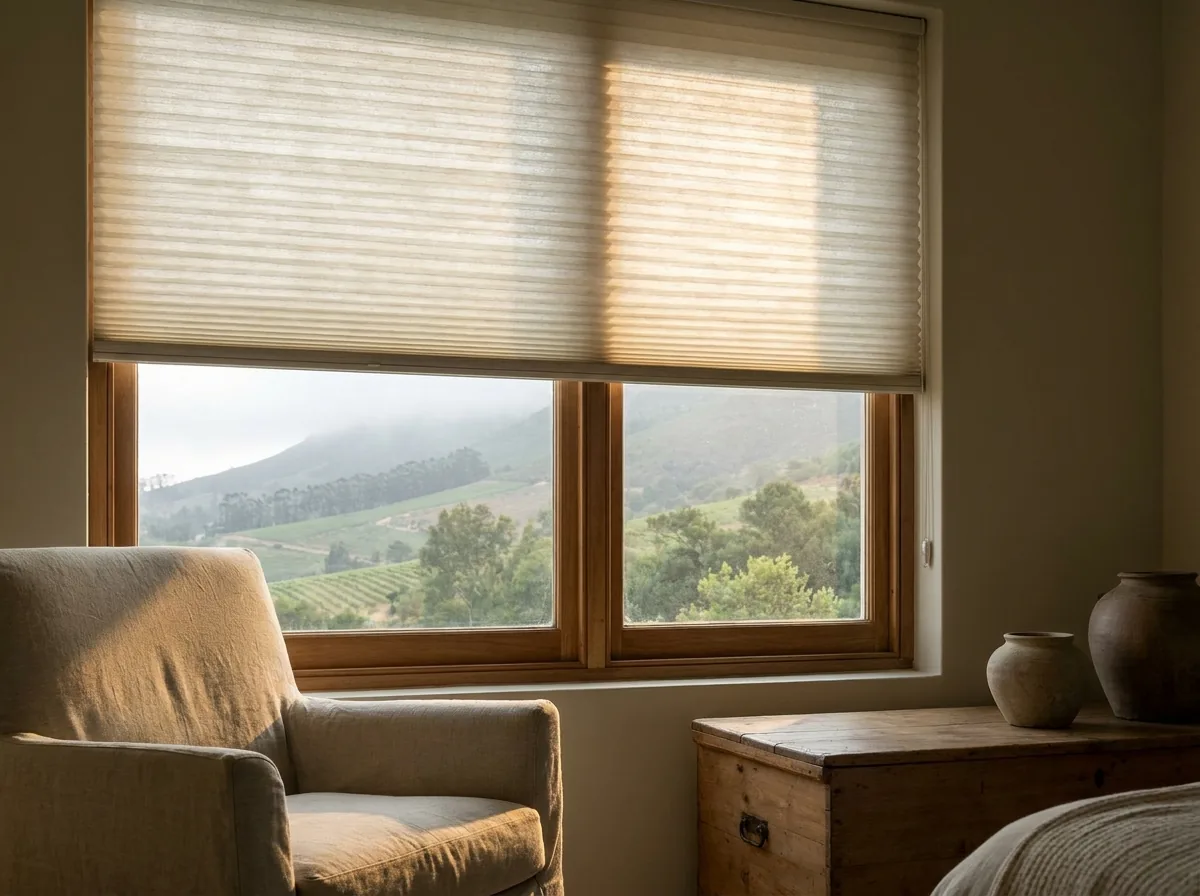
Where a room is lived in from morning to night, or where cold air pours off the glass on a clear valley winter night, a honeycomb blind earns its place. The air trapped in its cells is a genuine insulator, slowing heat coming in through summer glass and slowing warmth escaping in winter — a real comfort and energy pick rather than just a light control.
Bedrooms, TV rooms and north/south rooms used all day; anyone chasing a more even indoor temperature and lower running cost.
The cell fabric shows dust over the years more than a flat roller, and top-down/bottom-up versions cost more. If insulation isn't the priority, a plain roller does the light job for less.
One control for a whole wall that tracks the sun on its own.
On a double-volume wall of glass, a row of high clerestory windows, or a wine-estate elevation with six blinds that should move together, motorisation stops being a luxury and becomes the practical answer. A schedule lowers the west blinds as the afternoon sun swings round and lifts them at sunset; a wind sensor protects an awning without you thinking about it.
Tall, wide or numerous windows; anything out of comfortable reach; homeowners who want the whole house managed from a phone or on a timer.
Higher upfront cost and it needs power routed to each blind (worth planning during a build or renovation). On a single, easy-to-reach window, an honest manual chain does the same job for far less.
Shade that respects the south-easter.
For an outdoor space, the choice comes down to how exposed it is to the wind. A folding-arm awning gives clean overhead shade with open sides — breezy, but even with a wind sensor it must pull in when the Cape Doctor gets up. A zip screen locks the mesh into side tracks, so it holds in stronger wind and encloses the space against a wet winter, at the cost of a more room-like feel. On an exposed mountainside or valley-mouth patio we'd lean toward zip screens; on a sheltered courtyard, the awning.
Awning: sheltered patios and decks wanting flexible overhead shade. Zip screen: exposed or windy spaces you want usable through more of the year.
An awning must retract in strong south-easter, so it's not "always there"; a zip screen encloses more and costs more. Both should be motorised with a wind sensor on any exposed Stellenbosch elevation.
Heritage & estate notes
Stellenbosch adds constraints most towns don't. The historic core around Dorp Street holds one of the longest surviving rows of old buildings and oaks of any major South African town — the oaks are declared national monuments — and the town carries among the most heritage sites in the country. On a protected or character home the window itself is part of what's protected: deep plastered reveals, small-paned sashes and arched heads reward a blind chosen to sit within the opening and defer to the joinery, rather than a bulky cassette bolted across it. Inside-mounted timber venetians and slim sunscreen rollers usually do this best.
At the other end of town, the wine and golf estates — De Zalze, the Paradyskloof estates, Welgevonden — typically run architectural guidelines on anything visible from outside. That steers the specification toward concealed blind boxes planned in with the architect, motorised external venetians in a muted, estate-matched tone, and colour-matched cassettes. The most useful move on any estate home is to involve us early, while the plans are still with your architect, so shading is designed in rather than retro-fitted around a committee's rules later.
The honest part
A guide narrows the field; it can't finish the job. These are the five things we genuinely can't know until we're standing at your actual window — and any of them can change the recommendation above.
Cape Dutch and older homes have deep, hand-plastered reveals of no standard size. That depth decides whether a blind mounts inside or outside the opening, and whether a slim cassette or motor will physically fit — it has to be measured, not assumed.
On 150-year-old plaster, soft brick or stone, the real question is what a bracket — or the weight of a motor and headbox — can safely fix to. We check the lintel and substrate before promising a fixing.
The south-easter funnels differently at every address. A mountainside or valley-mouth site may rule an awning out in favour of a zip screen, and it sets the wind-sensor threshold. We can only judge that on the spot.
Motorisation is easy in theory; on a heritage wall where surface trunking isn't acceptable, the routing of power to each blind is the thing that makes or breaks a clean finish. We plan that route on site.
If you're in an estate, the committee's permitted colours and finishes for anything visible outside need confirming before we manufacture. We'd rather check first than remake.
Two ways forward
The proper way is the free in-home measure below: a consultant sees your actual windows and light, and you get exact, per-window pricing with no guesswork. If you'd just like a rough budget range first, you can pop your own rough sizes into the list below and we'll send a ballpark by the next working day. Not sure how to measure? Leave those fields blank — our consultant measures everything for free, and the exact figures come from that visit.
Stellies Blinds — my window list
Rough sizes in millimetres. Blanks are fine — your free measure confirms the exact figures.
Your ballpark, in about two minutes.
| Room | Width (mm) | Drop (mm) | Inside / outside reveal | Product | Remove |
|---|
Nothing is sent from this table on its own. When you book your free measure below, this list travels with your request automatically — so you don't type it twice. No photos or uploads needed; if we need a picture of anything tricky, a consultant will ask in the reply.
The close
A consultant comes to you with fabric and mesh samples, measures every opening precisely, and specifies fabric, openness and motorisation room by room. It costs nothing, there's no obligation, and you leave with a written, per-window quote.
Download the PDF if you want this to hand when you measure.